


Every physician practice eventually asks the same question: is our billing process earning what it should, and is it worth the staff time it takes? Physician billing services take over the work between a patient visit and a final payment. In particular, that work includes verifying coverage, checking charges, submitting claims, posting payments, and chasing denials. This guide explains what those services cover, what they may cost, and how to decide between in-house, outsourced, and hybrid billing.
Key Takeaways
- Physician billing services cover the full claim lifecycle, from eligibility checks to denial appeals and reporting, but scope varies by vendor and must be confirmed in writing.
- Pricing is usually a percentage of collections, a flat or per-provider fee, or a per-claim fee. The headline rate is rarely the whole cost.
- Outsourcing is not automatically cheaper. It tends to pay off when denials, A/R delays, staffing gaps, or growth are straining the in-house team.
- A hybrid model can work when you want to keep front-desk tasks in-house and hand off claims follow-up and A/R.
- Before signing, review the contract for scope, reporting, data ownership, HIPAA terms, and exit rights.
What Are Physician Billing Services?
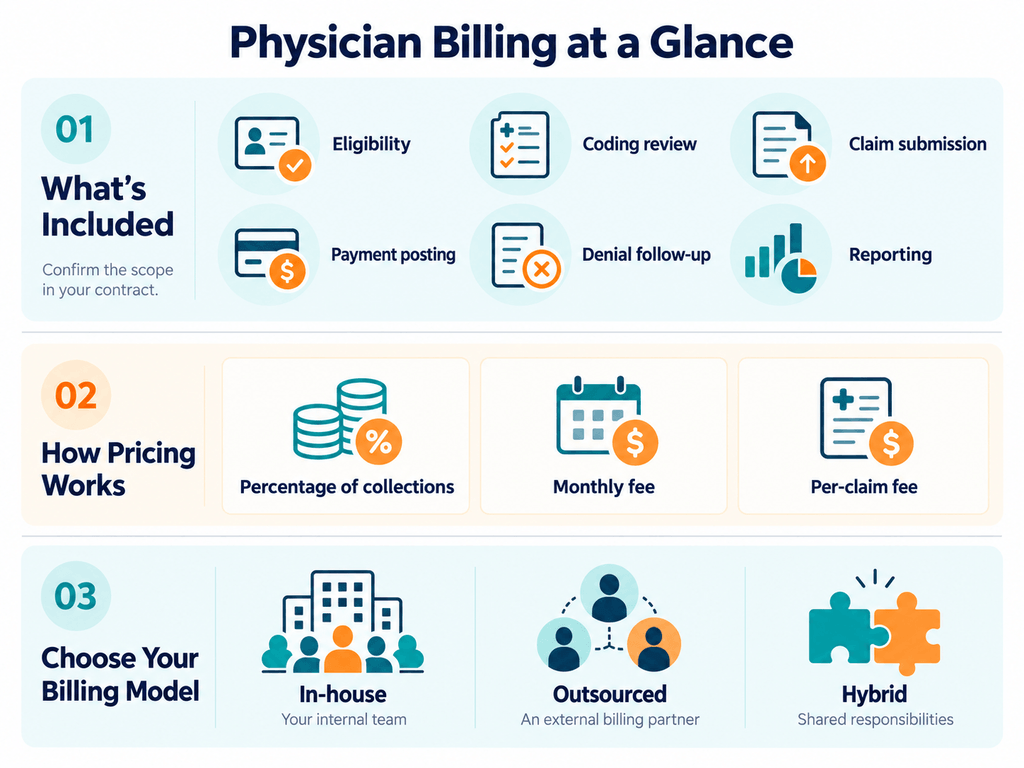
Physician billing services are the administrative and financial tasks that turn a patient encounter into a paid claim. A billing team, whether in-house or outsourced, confirms what the payer owes, submits the claim, tracks the response, and collects any remaining balance from the patient.
Physician billing differs from hospital billing in format, rules, and workflow. Specifically, practices bill on professional claim forms and are paid for the physician’s work, while facilities bill separately for their own services. If you want to understand that split, see our guide on the difference between hospital billing and physician billing.
You will see the same service described in several ways, including medical billing services for physicians, physician billing solutions, physician billing management, and physician medical billing. They all describe the same core job: getting accurate claims paid quickly. However, some vendors offer only part of that job, so the label alone tells you little. For that reason, the contract and service description matter more.
What’s Included in Physician Billing Services?
A full-service arrangement typically covers the steps below. A narrower arrangement may handle only some of them.
Patient Information and Insurance Eligibility
Billing starts before the visit. The team collects demographics and insurance details, then verifies active coverage, benefits, and any authorization requirements. Because errors here are a common source of avoidable denials later, many practices treat front-end accuracy as the highest-value part of billing.
Charge Entry, Coding Review, and Claim Scrubbing
After the visit, however, the service converts documentation into billable charges. Coding review checks that procedure and diagnosis codes support the documented care. Claim scrubbing then screens each claim for missing data and edit errors before it goes to the payer. If coding is a weak point for your practice, our medical coding services page explains how that support works.
Claim Submission and Rejection Follow-Up
Next, clean claims are submitted electronically to the payer or through a clearinghouse. Rejections, which are claims bounced for formatting or data issues before they enter payer adjudication, should be worked quickly and resubmitted. For this reason, ask any vendor how fast rejections are reviewed and who owns the fix.
Payment Posting and Reconciliation
Third, each insurance payment and remittance must be posted to the right account and matched against what was expected. In addition, reconciliation catches underpayments, missed adjustments, and payments that never arrived. Without it, revenue leaks quietly.
Denial Management, Appeals, and A/R Follow-Up
Denials need two responses: fix the claim, and fix the cause. In practice, a good team tracks denial reasons, files appeals with supporting documentation, and works aging accounts receivable instead of letting old balances expire. For more on this stage, read about healthcare accounts receivable management.
Patient Billing and Performance Reporting
Once insurance pays, the remaining balance goes to the patient through statements and follow-up. Finally, reporting should show the numbers you need to manage the practice: clean claim rate, denial rate, days in A/R, and collections by payer.
Scope Checklist for Your Contract
Use this table to compare vendors line by line.
| Service | Work performed | What to confirm in the contract |
|---|---|---|
| Eligibility and registration | Verify coverage, benefits, and authorization needs | Who verifies, how far ahead of the visit, and how prior authorization is handled |
| Charge entry and coding review | Enter charges, check code accuracy | Whether certified coders are included or billed separately |
| Claim scrubbing and submission | Screen claims, submit electronically | Clearinghouse ownership and fees |
| Rejection follow-up | Correct and resubmit rejected claims | Turnaround expectations |
| Payment posting | Post payments, reconcile remittances | Frequency of posting and who reviews underpayments |
| Denial management and appeals | Analyze denials, file appeals | Appeal limits, timelines, and denial reporting |
| A/R follow-up | Work aging balances by payer | Follow-up cadence and escalation process |
| Patient billing | Statements, balance follow-up | Who handles patient calls and payment plans |
| Reporting | Performance dashboards and reviews | Report frequency, metrics, and data access |
What May Cost Extra?
A quoted rate often covers the core billing cycle, and some items fall outside it. Ask whether any of these are charged separately:
- Credentialing and payer enrollment
- Prior authorization support
- Patient statements, mailing, and phone support
- Clearinghouse or software fees
- Setup, onboarding, or data migration
- Cleanup of old or aging A/R
- Custom reporting
- Coding audits or documentation reviews
- Early termination or data-transfer fees
None of these is necessarily a problem. However, the risk is finding them after you have signed. Therefore, ask for a written list of what the fee covers and what it does not.
How Much Do Physician Billing Services Cost?
There is no single price. Instead, billing companies structure fees differently, and the right model depends on your volume, payer mix, and how much of the cycle you hand off. Overall, the most common structures are below.
Percentage of Collections
In this model, the vendor charges a percentage of the money your practice actually collects. This ties the vendor’s income to your results, which many practices like. However, it can grow with revenue, so check how the percentage is calculated and whether it applies to patient payments, adjustments, or old A/R.
Here is a hypothetical example, not a quote. If a practice collects $100,000 in a month and the agreed fee is 5% of collections, the fee for that month would be $5,000. A different rate, a different scope, or add-on fees would change the number. Therefore, treat this only as an illustration of the math.
Flat Monthly or Per-Provider Fees
In contrast, a fixed monthly fee, or a fee per provider, makes budgeting predictable. It works best when volume is steady. However, the tradeoff is that the fee does not rise or fall with your collections, so confirm what happens if your volume changes significantly.
Per-Claim Pricing
Alternatively, some vendors charge a set amount for each claim processed. This can suit practices with low or uneven volume. Before signing, ask whether reworked claims, resubmissions, and appeals count as new claims, since that affects your real cost.
What Changes the Final Quote?
Several factors move the price up or down:
- Specialty: Some specialties involve more complex coding and payer rules.
- Claim volume: Higher volume can lower the unit cost, but not always.
- Payer mix: A heavy Medicare, Medicaid, or out-of-network mix can need more follow-up.
- Clean A/R vs. backlog: Old, unworked claims often require extra effort.
- Systems: Your EHR, practice management system, and clearinghouse affect setup and ongoing work.
- Scope: Full-service billing costs more than claim submission alone.
For this reason, compare vendors on total cost to the practice, not just the rate. A lower percentage with several add-on fees can cost more than a higher all-inclusive rate.
In-House vs. Outsourced vs. Hybrid Billing
No model fits every practice. For this reason, here is how the three compare.
| Factor | In-house | Outsourced | Hybrid |
|---|---|---|---|
| Control | Highest day-to-day control | Shared, set by contract | Split by task |
| Cost structure | Salaries, benefits, software, training | Fee based on collections, volume, or flat rate | Lower staffing plus a smaller vendor fee |
| Expertise | Depends on your hires | Access to a trained team | Specialist help where you need it |
| Coverage | Gaps during turnover or leave | Team coverage | Depends on the split |
| Scalability | Requires hiring | Scales with volume | Flexible |
| Best fit | Stable teams that want full control | Practices with denials, delays, or staffing strain | Practices that want to keep some tasks internal |
In-house billing keeps everything under your roof, which suits practices with experienced billers and stable volume. However, the risks are turnover, training gaps, and the cost of keeping up with payer changes.
Outsourced billing moves most or all of the work to a specialist team. However, it does not remove your responsibility for accurate documentation and oversight, but it can relieve staffing pressure.
Hybrid billing splits the work. A common version keeps scheduling, registration, and patient communication in the office, while a vendor handles claim follow-up, denials, and A/R. As a result, this helps when you want specialist support without giving up front-desk control.
Outsourcing is not always cheaper. Instead, the comparison should include salaries, benefits, software, training, and the revenue lost to denials and slow follow-up, not only the vendor’s fee. Our article on revenue cycle management vendor selection covers what to weigh when comparing providers.
When Should a Physician Practice Outsource Billing?
Consider outsourcing, or a hybrid model, when you see several of these signs:
- Denials are rising or recurring. The same denial reasons keep appearing and nobody has time to fix the root cause.
- A/R is aging. Unpaid claims sit while staff handle other work.
- Billing depends on one or two people. A resignation or leave would stall your cash flow.
- You are growing. New providers, locations, or payers add work faster than you can hire.
- Providers are doing billing tasks. Clinical time is going to administrative work.
- You lack reporting. You cannot easily see denial rate, clean claim rate, or days in A/R.
- Payer rules keep changing and your team is behind.
Small practices often feel this first because one billing gap can affect cash flow quickly. If your current process is stable and your numbers are healthy, you may not need to change anything. Either way, a review of your key metrics is a reasonable first step before deciding.
Questions to Ask Before Choosing a Billing Company
Use these questions in every vendor conversation:
- Which services are included in the base fee, and which cost extra?
- Who will manage our account, and how often will we meet?
- How do you handle denials and appeals, and how do you report on denial trends?
- Which reports will we receive, and how often?
- Who owns our data, and how do we get it back if we leave?
- Which systems do you work in, and do you work in our EHR or practice management software?
- How do you protect patient information and train staff on privacy?
- What are the contract term, notice period, and exit terms?
On privacy: a billing company that handles protected health information is generally a business associate under HIPAA. The U.S. Department of Health and Human Services explains the requirements in its business associate guidance. In addition, your practice should have a business associate agreement in place before any patient data is shared.
How to Transition Without Losing Track of Claims
A careful handoff protects your cash flow. To do this, follow these steps:
- Take inventory. List open claims, aging A/R, pending appeals, and unposted payments.
- Decide who owns what. Agree in writing which claims the new team works and which stay with your staff.
- Set up access. Complete the business associate agreement and arrange system access and clearinghouse connections.
- Confirm payer details. Make sure payer enrollments, remittance routing, and contact information are correct.
- Run a parallel period if possible. Compare results before fully switching.
- Agree on reporting. Set the first reports and review dates before work starts.
- Review early. Check the first few weeks of claims, denials, and payments, then adjust.
We avoid promising a fixed timeline because it varies with your systems, specialty, and backlog. Instead, ask any vendor for a written transition plan with milestones.
Discuss Your Physician Billing Needs With panaHEALTH
If you are weighing in-house, outsourced, and hybrid billing, panaHEALTH can review your current process and show where claims are slowing down. Our medical billing services and revenue cycle management services are built for U.S. physician practices, and we can recommend the level of support that fits your size and specialty.
Talk to a billing specialist at panaHEALTH to review your scope, reporting, and options.
Frequently Asked Questions
Scope, Cost, and Outsourcing Questions
They typically cover eligibility checks, charge entry, coding review, claim submission, payment posting, denial management, A/R follow-up, patient billing, and reporting. Exact scope differs by vendor, so confirm it in the contract.
Cost depends on the pricing model, specialty, claim volume, payer mix, and scope. Common models are a percentage of collections, flat or per-provider fees, and per-claim fees. Finally, ask for a written quote that lists every fee.
It can be, particularly when denials, aging A/R, or staffing gaps are costing the practice money. However, it is not automatically cheaper, so compare total in-house cost against the vendor’s full fee.
Physician billing covers professional services and uses professional claim formats. Hospital billing, in contrast, covers facility charges. As a result, the two follow different rules and are billed separately.
Coding translates documented care into standardized codes. Billing, in turn, uses those codes to submit claims and collect payment. Many services bundle both, but some charge for coding separately.
Billing Models, Contracts, and Compliance Questions
Yes. Small practices often benefit because one staff absence or billing delay can disrupt cash flow. In addition, per-claim and percentage models can make outsourcing practical at lower volumes.
In a hybrid model, your office keeps some tasks, such as registration and patient communication, while a vendor handles others, such as claim follow-up, denials, and A/R.
Check scope, fee structure, add-on charges, reporting, data ownership, HIPAA terms, contract length, notice period, and what happens to your data and open claims if you leave.
Generally, yes. A billing company that handles protected health information on your behalf is typically a business associate, and HIPAA calls for a written agreement. For details, see the HHS guidance linked above.
Warning signs include rising denials, aging A/R, dependence on a few staff members, and limited reporting. Therefore, reviewing your clean claim rate, denial rate, and days in A/R is a good starting point.