


Key Takeaways
- CPT 99214 is a level-4 office visit for an established patient. It needs moderate medical decision making (MDM) or at least 30 minutes of total practitioner time on the date of service (AMA CPT via AAFP).
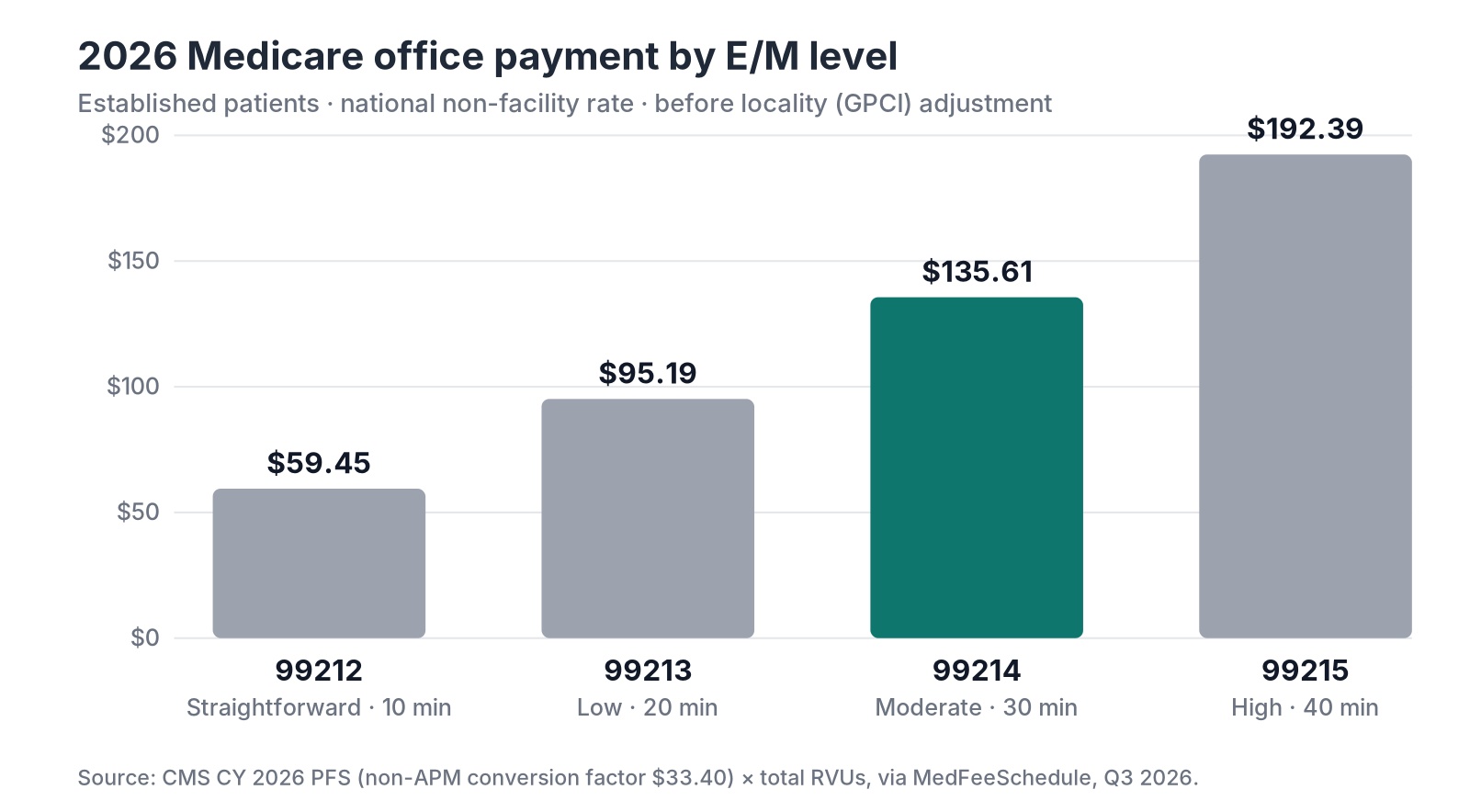
- The 2026 Medicare national rate is $135.61 in the office and $84.50 in a facility, before local adjustment (MedFeeSchedule).
- 99214 is Medicare’s most-billed E/M code and its top source of improper payments: $564 million, with 63.4% of errors due to incorrect coding.
- When coding by time, you only need to record total time, not a task-by-task log.
CPT 99214 pays about $40 more than 99213 per Medicare office visit. It’s also the code auditors check first. Getting it right isn’t about billing higher; it’s about documenting what you already do so the level holds up. This guide covers the rules as they stand for 2026, with worked examples your providers can use tomorrow.
What Is CPT 99214?
CPT 99214 reports an office or other outpatient visit for an established patient that involves a moderate level of MDM, or 30 minutes or more of total time on the date of the encounter. “Established” means the patient received professional services from the same physician, or another physician of the same specialty and subspecialty in the same group, within the past three years.
History and exam still need to be medically appropriate, but since the 2021 E/M overhaul they no longer set the level. You choose the level by MDM or time, whichever supports the higher code.
Where 99214 sits in the established-patient family
| Code | MDM level | Total time (must be met or exceeded) | 2026 Medicare office rate* |
|---|---|---|---|
| 99211 | Not required | — | — |
| 99212 | Straightforward | 10 min | $59.45 |
| 99213 | Low | 20 min | $95.19 |
| 99214 | Moderate | 30 min | $135.61 |
| 99215 | High | 40 min | $192.39 |
*National non-facility rates, CY 2026, before GPCI adjustment (MedFeeSchedule). Time thresholds are the CPT 2024 minimums, which replaced the old time ranges (AAFP FPM, Jan 2024).
How Do You Qualify a Visit for 99214?
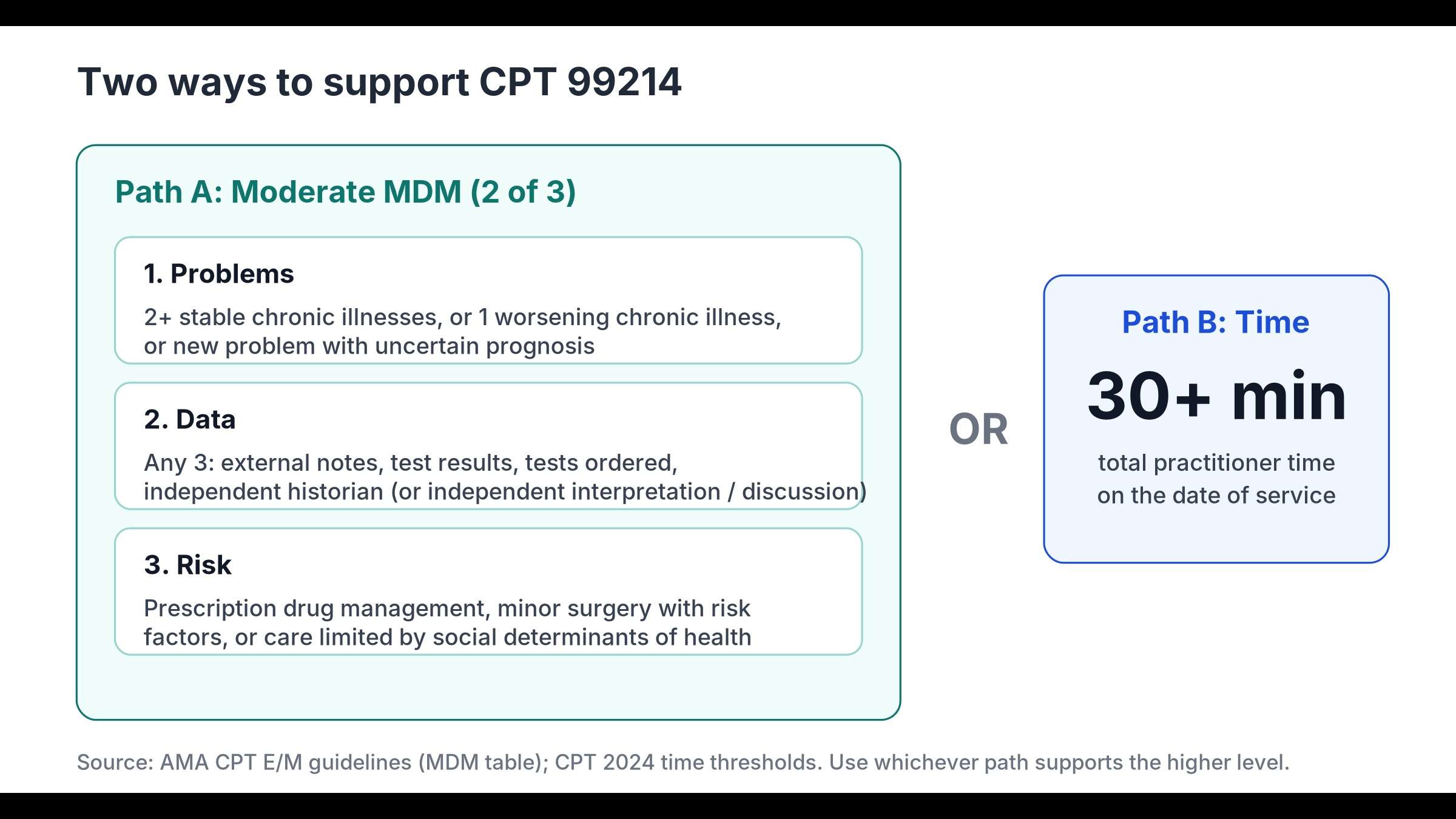
A visit qualifies for 99214 by one of two paths: moderate MDM, meeting 2 of the 3 MDM elements, or 30+ minutes of total practitioner time. Most chronic-care follow-ups qualify through MDM. Long counseling or coordination visits often qualify more easily through time.
Path A: Moderate medical decision making
You need two of the three elements at the moderate level or higher. The definitions below come from the AMA’s MDM table.
| MDM element | What counts as “moderate” |
|---|---|
| Number and complexity of problems addressed | 1+ chronic illness with exacerbation, progression or side effects of treatment; or 2+ stable chronic illnesses; or 1 undiagnosed new problem with uncertain prognosis; or 1 acute illness with systemic symptoms; or 1 acute complicated injury |
| Amount and complexity of data (meet 1 of 3 categories) | Category 1: any combination of 3: review of prior external notes from each unique source, review of each unique test result, ordering of each unique test, assessment requiring an independent historian. Category 2: independent interpretation of a test performed by another physician (not separately reported). Category 3: discussion of management or test interpretation with an external physician or other qualified professional |
| Risk of complications from patient management | Prescription drug management; decision about minor surgery with identified patient or procedure risk factors; decision about elective major surgery without identified risk factors; diagnosis or treatment significantly limited by social determinants of health |
Source: AMA CPT E/M descriptors and guidelines.
The most common 99214 pattern
Two stable chronic conditions plus prescription drug management meets moderate on problems and risk. Data doesn’t matter. This single pattern covers a large share of internal medicine and family medicine follow-ups.
Coder’s note: “Prescription drug management” means the provider evaluates the medication and makes a decision: continue, adjust or stop. Simply listing a medication or writing a refill without evaluating it usually doesn’t meet the definition. Document the decision and why.
Path B: Total time of 30 minutes or more
If total practitioner time on the date of the encounter reaches 30 minutes, the visit supports 99214 regardless of MDM. Time includes face-to-face and non-face-to-face work by the physician or other qualified health professional on that calendar date.
| Counts toward time | Does not count |
|---|---|
| Preparing to see the patient (for example, reviewing tests) | Clinical staff time |
| Obtaining or reviewing separately obtained history | Travel |
| Performing a medically appropriate exam | Separately reported services (for example, a procedure or an interpreted EKG billed on its own) |
| Counseling and educating the patient, family or caregiver | General teaching not tied to this patient’s management |
| Ordering medications, tests or procedures | Work on a different date |
| Referring and communicating with other professionals | |
| Documenting in the health record | |
| Independently interpreting and communicating results | |
| Care coordination |
Source: AMA CPT E/M guidelines; CMS MLN E/M Services Guide.
How to document time: state the total minutes on the date of service. The AMA confirms there’s no requirement to log time per task (AMA). A short summary of what the time covered makes the note much easier to defend in an audit.
Example attestation: “I spent a total of 34 minutes on this patient’s care today, including review of outside cardiology records, examination, counseling on the medication change, and documentation.”
99213 vs 99214: Worked Examples
The difference between 99213 and 99214 is usually one element: a second chronic problem, a worsening condition, or a real medication decision. These examples show where the line falls.
| Scenario | Problems | Data | Risk | Code |
|---|---|---|---|---|
| Stable hypertension; BP at goal; lisinopril continued after review | Low (1 stable chronic) | Minimal | Moderate (Rx management) | 99213: only 1 element at moderate |
| Hypertension and type 2 diabetes, both stable; A1c reviewed; metformin continued, amlodipine increased | Moderate (2 stable chronic) | Limited | Moderate (Rx management) | 99214 |
| COPD with increased dyspnea; chest X-ray and CBC ordered; pulmonology note reviewed; inhaler changed | Moderate (exacerbation) | Moderate (3 items) | Moderate | 99214 |
| New knee pain after a fall; X-ray ordered; OTC analgesic advised | Low (acute uncomplicated injury) | Limited | Low | 99213 |
| Same knee visit, but 32 minutes total including counseling and coordination | — | — | — | 99214 by time |
| Depression follow-up, stable on sertraline; housing insecurity limits therapy access | Low–Moderate | Minimal | Moderate (SDOH limits treatment) | 99214 only if problems also reach moderate (e.g., 2 chronic conditions addressed) |
99214 Documentation Checklist
A defensible 99214 note makes each MDM element visible without the auditor having to infer it. Use this checklist before signing:
- Every problem addressed is named with its status: stable, worsening, improving, new
- Each problem links to an action in the assessment and plan
- Tests ordered and results reviewed are listed individually
- External records reviewed are named with their source (for example, “reviewed cardiology note dated 9/12”)
- Medication decisions are explicit: started, stopped, dose changed, or continued after evaluation
- Any social determinants that limit diagnosis or treatment are described
- If coding by time: total minutes on the date of service are stated
- ICD-10-CM codes reflect the severity documented (for example, “with hyperglycemia”, “with exacerbation”)
What Does 99214 Pay in 2026?
Medicare’s 2026 national rate for 99214 is $135.61 in the office and $84.50 in a facility setting. These figures are the total RVUs (4.06 non-facility, 2.53 facility) multiplied by the CY 2026 non-APM conversion factor of $33.40, which rose 3.26% from 2025 (CMS fact sheet).
| Setting | Work RVU | PE RVU | MP RVU | Total RVU | 2026 national rate |
|---|---|---|---|---|---|
| Office (non-facility) | 1.92 | 2.00 | 0.14 | 4.06 | $135.61 |
| Facility | 1.92 | 0.47 | 0.14 | 2.53 | $84.50 |
Source: MedFeeSchedule, CPT 99214. Your actual payment depends on your locality’s GPCI; commercial and Medicaid rates vary by contract.
Two 2026 changes worth knowing:
- E/M is protected from the “efficiency adjustment.” CMS applied a −2.5% cut to work RVUs for non-time-based services in 2026, but explicitly exempted time-based codes, including E/M (CMS).
- Facility-setting rates fell. Office E/M rates rose while facility rates dropped. For example, 99213 is up 7.02% in the office but down 9.84% in a facility (MedFeeSchedule). Check the place of service on hospital-based clinic claims carefully.
What undercoding costs
At 2026 Medicare office rates, each visit billed as 99213 that supported 99214 leaves $40.42 unpaid. A provider who undercodes 3 visits a day, 4 days a week, 48 weeks a year loses about $23,300 a year at Medicare rates alone (3 × 4 × 48 = 576 visits × $40.42).
Can You Add G2211 or Modifier 25 to 99214?
Yes to both, in the right circumstances, but they carry different rules.
G2211: visit complexity add-on (Medicare)
G2211 can be added to 99202–99215 when the practitioner has a longitudinal relationship with the patient. That means either serving as the continuing focal point for all needed services, or providing ongoing care for a single serious or complex condition (CMS MLN MM13473). When introduced in 2024 it added roughly $16 per eligible visit (AAFP).
- Not payable when the E/M carries modifier 25, except (from January 1, 2025) when the other service is an annual wellness visit, vaccine administration or Part B preventive service (CMS).
- Document the ongoing relationship. For a one-off visit with no plan for continuing care, don’t add G2211.
Modifier 25: significant, separately identifiable E/M
Add modifier 25 to 99214 when you perform a procedure or preventive service on the same day and the E/M is significant and separately identifiable. The E/M documentation must stand on its own without the procedure’s pre-service work.
Why 99214 Gets Audited, and How to Avoid Denials
99214 attracts audits because of volume and error rate. Medicare paid more than $12 billion for it in 2023 claims, and CMS’s 2024 improper payment data found $564 million paid in error. Incorrect coding, mostly documentation supporting a lower level, made up 63.4% of those errors (MedCentral).
| Error / denial | Typical cause | Prevention |
|---|---|---|
| Downcoded on review (documentation supports 99213) | “Stable” problems with no evaluation or decision recorded | Checklist above; document the medication decision |
| No or insufficient documentation (36.6% of errors combined) | Unsigned notes, missing addenda, cloned text | Sign and date promptly; avoid copy-forward without updating |
| CO-97: bundled into a procedure | E/M billed with a same-day procedure without modifier 25 | Use modifier 25 only when the E/M is separately identifiable |
| G2211 denied | Billed with modifier 25 alongside a non-exempt service | Follow the 2025 exceptions list |
| Peer-comparison audit flags | 99214/99215 share far above specialty peers | Quarterly internal E/M coding audit |
Best practice: audit 10 random E/M notes per provider per quarter. Compare the billed level with the level the documentation supports, and give each provider feedback. Both over- and under-coding trends show up within one or two cycles.
Frequently Asked Questions
What is the time requirement for CPT 99214?
At least 30 minutes of total practitioner time on the date of the encounter, including non-face-to-face work such as record review and documentation. The old 30–39 minute range was replaced by a minimum in CPT 2024.
Can 99214 be billed for a new patient?
No. 99214 is for established patients only. The new-patient equivalent is 99204, which requires moderate MDM or at least 45 minutes of total time.
Do I need to document time for each task?
No. The AMA says documenting total time on the date of service is enough when time determines the level.
Is 99214 billable via telehealth?
Generally yes, under Medicare and most commercial payers, when the service meets the code’s requirements. Use the place of service and modifier the payer requires (for example, POS 02 or 10, modifier 95). Confirm current telehealth policy for each payer.
How much does 99214 pay in 2026?
The Medicare national rate is $135.61 (office) and $84.50 (facility), adjusted by your locality. Commercial rates vary by contract.
What’s the most common reason 99214 gets downcoded?
Documentation that lists problems as “stable” without showing evaluation or a management decision. That reads as low MDM, which supports 99213.
Get E/M Levels Right Before the Claim Goes Out
Certified coders who review E/M levels before submission catch under- and over-coding before payers do. panaHEALTH’s medical coding services include pre-bill E/M review, provider feedback and quarterly audits, so every level you bill is one you can defend.