
Key Takeaways
- Urgent care centers bill most visits with standard E/M codes (99202–99215) and place of service 20, defined by CMS as a location distinct from an ER, office or clinic for unscheduled, ambulatory patients needing immediate attention.
- Many commercial payers also allow S9088, an add-on billed with E/M, or require S9083, a global case rate that replaces E/M. Medicare pays neither S-code; bill E/M and procedures only.
- Choosing the wrong code set for a payer is a common cause of avoidable urgent care denials, and the wrong POS code alone can misalign reimbursement or trigger rejection.
Urgent care billing looks simple: high volume, short visits. In practice it’s harder, because each payer contract treats the same visit differently, and centers see far more walk-in, self-pay and out-of-network scenarios than a scheduled office. Here’s how the coding actually works, and where the revenue leaks tend to show up.
Why Urgent Care Billing Is Different
| Factor | Primary care office | Urgent care center |
|---|---|---|
| Patients | Mostly established | Mostly new, walk-in |
| Coding | E/M + chronic-care add-ons | E/M or payer-specific S-codes + procedures |
| Eligibility | Verified ahead of the visit | Verified at the counter, in minutes |
| Hours | Business hours | Evenings, weekends, holidays |
| Place of service | POS 11 (Office) | POS 20 (Urgent Care Facility) |
Individual urgent care centers report daily volumes in the range of roughly 100–170 patients, with winter peaks pushing higher, based on member-reported figures from the Urgent Care Association (UCA). That volume magnifies small coding and eligibility errors quickly.
The Core Urgent Care Codes
1. E/M codes (all payers, including Medicare)
- New patients: 99202–99205
- Established patients: 99212–99215
- Level is chosen by medical decision making or total time, as in any office setting — see our CPT 99214 guide for how the criteria work.
2. S9088: services provided in an urgent care center (List Separately in Addition to Code for Service)
- An add-on code, billed with the E/M code, never alone
- Accepted by many commercial payers when the contract allows it, to compensate for the added cost of urgent-care staffing and equipment
- Never billed to Medicare, which does not recognize urgent care as a distinct site of service.
3. S9083: global fee urgent care centers
- A case rate that replaces the E/M code and bundles the visit into one flat payment
- Use only when a specific payer contract requires it
- Reimbursement doesn’t scale with acuity, so it can underpay a moderate-complexity visit (for example, laceration repair plus an X-ray) relative to a straightforward one.
4. After-hours codes
| Code | Meaning | Notes |
|---|---|---|
| 99050 | Services provided outside regularly scheduled office hours | Payer-specific acceptance |
| 99051 | Services provided during regularly scheduled evening, weekend or holiday hours | Common in urgent care; can be billed alongside S9088 and E/M on the same visit; not paid by Medicare. |
5. Procedures and ancillaries to capture separately
Laceration repair (120xx series), splinting and casting (29xxx series), incision and drainage (10060), CLIA-waived rapid tests (for example, strep and flu, with modifier QW where required), diagnostic X-rays, and injections (96372). These are billed in addition to the E/M or global fee and are the most common source of missed revenue when front-line staff don’t chart every service performed.
S9083 vs S9088 vs E/M: Which to Bill?
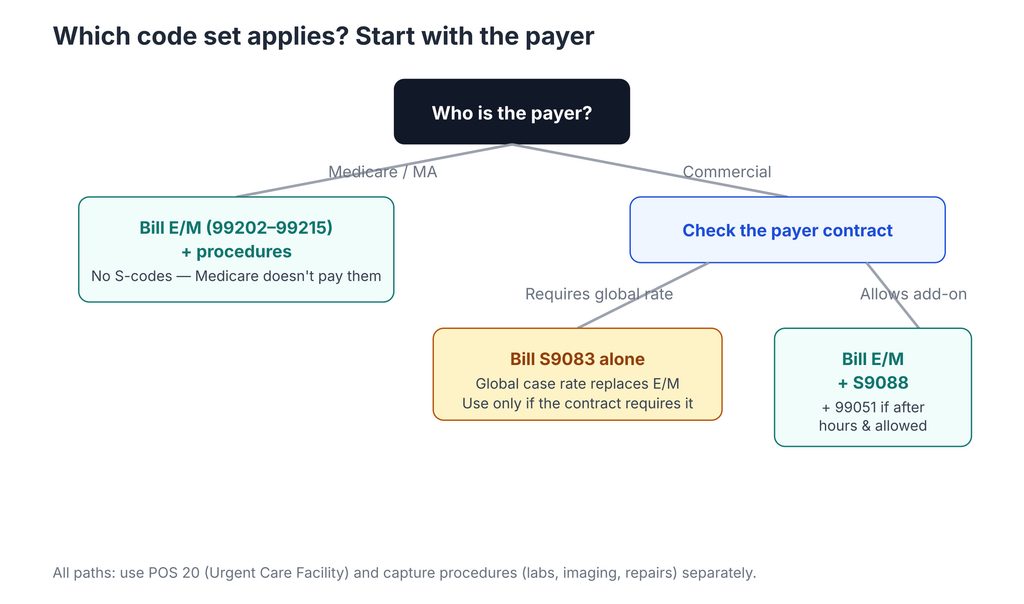
The payer decides which code set applies, not the visit type. Build the logic into your practice management system so charge entry doesn’t rely on memory.
| Payer situation | Bill |
|---|---|
| Medicare / Medicare Advantage | E/M + procedures, no S-codes |
| Commercial payer allowing the urgent-care add-on | E/M + S9088 (+ 99051 if applicable) |
| Commercial payer contract requiring a global rate | S9083 (replaces E/M) |
| Medicaid | Varies by state; check the state fee schedule |
Action step: Build a payer matrix in your practice management system that sets S9083, S9088 or E/M-only automatically by payer, so charge entry doesn’t rely on staff memory.
Place of Service 20: What It Means and Why It Matters
CMS defines POS 20 as “a location distinct from a hospital emergency room, an office, or a clinic, whose purpose is to diagnose and treat illness or injury for unscheduled, ambulatory patients seeking immediate medical attention”. It was established in 2003 specifically to separate urgent care from a standard physician office (POS 11).
- Your credentialing and payer enrollment must match POS 20. A location enrolled under one POS but billed under another can trigger claim rejection.
- The wrong POS code creates real payment problems, not just formality issues: incorrect copay calculations, claims processed at the wrong rate, or outright denial if the payer’s system has the facility set up under a different designation.
- Most payers follow CMS guidance and expect POS 20 for urgent care unless the specific contract says otherwise. Confirm this per payer rather than assuming.
Top Urgent Care Denials and Fixes
| Denial | Cause | Fix |
|---|---|---|
| Coverage / eligibility denial | Coverage not verified at check-in, common with walk-ins | Real-time eligibility at the front desk; re-verify returning patients every visit (eligibility verification errors) |
| Missing or incomplete information | Rushed walk-in registration | Required-field rules and ID/insurance card scanning at intake |
| Modifier or bundling denial | S9088 sent to a payer that doesn’t allow it, or a procedure bundled without modifier 25 | Payer matrix (above); use modifier 25 only when the E/M is significant and separately identifiable |
| Wrong payer / coordination of benefits | Workers’ comp or auto injury billed to the health plan | Ask “Is this work- or accident-related?” at intake, every time |
| Timely filing | Claims held for missing information past the payer’s filing limit | Daily claim-hold report; work holds within 48 hours |
| No Surprises Act / out-of-network issues | Patient’s plan isn’t contracted with the center | Provide good-faith estimates for self-pay; confirm when NSA protections apply |
Where Urgent Care Denial Rates Typically Sit
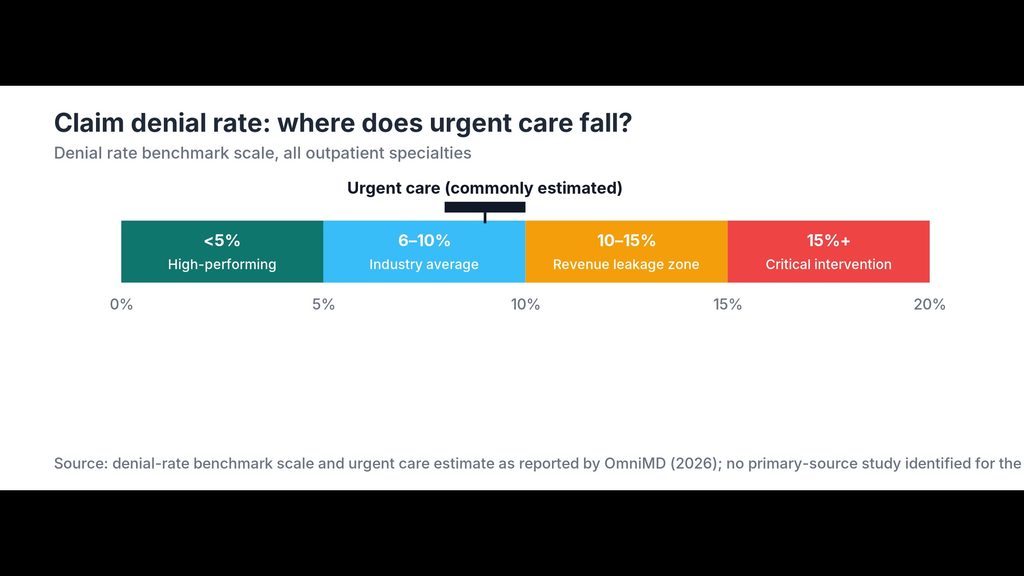
Industry denial-rate benchmarks generally place a high-performing practice under 5%, the industry average at 6–10%, 10–15% as a revenue leakage zone, and above 15% as needing critical intervention. Urgent care is commonly estimated in the 8–12% range, near the top of the industry-average band, which several sources attribute to rapid intake, incomplete insurance verification at the point of a walk-in visit, and documentation shortcuts under time pressure. Treat that range as a planning estimate, not a fixed target no primary-source study was found to confirm the exact figure, so benchmark it against your own trailing 12 months.
In-House or Outsourced?
High volume magnifies small errors: even a modest rise in the denial rate on 1,500 visits a month means dozens of extra claims to rework every cycle. Many centers outsource billing specifically because payer-by-payer S-code rules are easy to get wrong and expensive to miss, freeing front-desk staff to focus on registration and eligibility instead of claim logic.
Frequently Asked Questions
Does Medicare pay urgent care S-codes? No. Medicare doesn’t recognize S9083 or S9088. Bill standard E/M and procedure codes with the correct place of service.
Can S9088 be billed without an E/M code? No. S9088 is an add-on code and must accompany an E/M code on the same claim.
When should an urgent care center bill S9083? Only when a payer contract specifically requires the global case rate. Otherwise bill E/M, plus S9088 where the payer allows it.
Is 99051 billable in urgent care? Many commercial payers accept 99051 for evening, weekend or holiday visits during scheduled hours, alongside S9088 and E/M. Medicare does not pay it.
What place of service code does urgent care use? POS 20 (Urgent Care Facility), for a location enrolled and operating as an urgent care center, distinct from POS 11 (office).
Stop Leaving Urgent Care Revenue on the Table
panaHEALTH’s urgent care medical billing services include payer-specific S-code rules, same-day charge entry, procedure-capture review and denial management, built for high-volume, walk-in clinics.