Electronic Health Record (EHR) systems consume a large part of a provider’s workday. Studies show many physicians spend more time on EHR documentation than on face-to-face care. This extra documentation contributes to burnout and takes valuable time away from patients. Virtual scribe services offer real-time documentation support that allows providers to focus on delivering exceptional care.
What are Remote Medical Scribe Services?
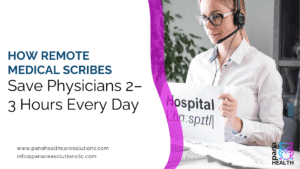
A remote medical scribe service provides trained professionals who listen in on patient visits (via phone or video) and document the encounter in real time. These scribes join consultations virtually and enter all the clinical information directly into the provider’s EHR. In other words, a remote medical scribe is a “virtual” documentation assistant. Unlike an in-person scribe who sits beside the doctor, a remote scribe connects from an off-site location using secure technology. This model enables providers to access skilled scribes without needing extra office space.
What Does a Remote Medical Scribe Do?
Remote medical scribes handle a variety of documentation and administrative tasks during patient encounters. It may include-
- Real-time charting
- EHR data entry
- Coordination tasks
- Pre-chart preparation
- Communication handling
How Remote Scribes Help with EHR Documentation
Partnering with skilled remote scribes helps providers to handle complex EHR documentation promptly. They help with-
Real-Time Data Entry
Remote scribes enter information into the EHR during the patient visit. By capturing data as the physician talks and examines the patient, scribes ensure no detail is missed. For example, panaHEALTH’s virtual scribe services “connect to your sessions via HIPAA-compliant platforms and document each patient encounter in real time,”. It ensures all medical information is captured accurately and thoroughly.
This real-time entry means charts are mostly done before the patient even leaves. It helps to reduce backlog and ensures the immediate availability of records for billing or follow-up.
Reduced Physician Workload
With a remote scribe handling documentation, physicians spend much less time on keyboarding and clicking. Instead, doctors can listen and talk to patients without interruption. This reduces physician workload by lifting the administrative load, handling everything from EHR navigation to coding support.
Improved Accuracy & Compliance
The quality of data in the EHR improves because scribes are dedicated to documentation. Trained remote scribes use standardized medical terminology and coding practices to ensure notes are complete and clear. They are HIPAA-trained to ensure that all necessary information is accurately captured using standardized medical terminology and attestation protocols. This attention to detail reduces errors and helps practices meet regulatory requirements (such as Medicare/Medicaid documentation rules). By consistently following templates and checklists, scribes make documentation more reliable and audit-ready.
Increased Efficiency & Revenue
Remote scribes boost practice productivity and revenue. When doctors spend less time charting, they can see more patients or spend more time per patient. One study of scribes in a clinic found a 10.5% increase in physicians’ work and an 8.8% increase in patients seen per hour. Scribes also help ensure billing details are entered correctly, reducing claim denials. They ensure 100% data accuracy to reduce future claim denials and speed up reimbursement.
Focus on Patient Care
Perhaps the most important benefit is that scribes let doctors give full attention to patients. Without having to take notes, providers make better eye contact, explain more clearly, and listen properly. Research shows that physicians using scribes have much better patient interactions, with clinicians listening and talking more to build stronger relationships.
Key Benefits for EHR Workflow
Timely chart completion, better quality data, and scalability are some of the major advantages of a remote medical scribe company.
Faster Chart Closure
Scribes speed up the process of finishing notes. Many charts are signed off by physicians within hours instead of days. Practices see fewer incomplete records at day’s end, reducing backlogs and late-night work for clinicians. Scribe services help complete documentation before the patient leaves, which reduces the chart backlog.
Better Quality Data
Because scribes concentrate on detail, EMR documentation support improves quality. Remote scribes use the same language and formats consistently, so records are more thorough and standardized. Studies have found that charts created with scribe help are more complete and accurate than those done by physicians under time pressure. This enhanced quality supports better clinical decisions and smoother billing.
Scalability
Remote scribe services are easily scalable with a practice’s needs. A clinic can add more scribes in busy seasons and can easily back down when the volume dips. All kinds of medical facilities, whether it’s small or large-sized hospitals, can benefit from remote medical scribe services.
Who Benefits Most from Remote Scribe Outsourcing?
Healthcare practices where administrative tasks eat into patient care time – from large health systems to one-doctor offices – stand to gain by outsourcing scribes. It may include-
Primary Care and Family Medicine
These doctors often have the highest EHR loads. A study of primary care physicians showed remote scribes significantly reduced total EHR time and improved measures of burnout and well-being.
Busy Clinics & Specialists
Practices with high patient volumes – such as urgent care, emergency departments, and large specialty groups – find scribes vital. They enable providers to maintain throughput without sacrificing note quality.
Small or Rural Practices
Virtual-scribe experts note that small or rural hospitals and clinics (where staff are few and burnout is high) benefit greatly from remote scribes. Since hiring an on-site scribe may be impractical, these providers can use remote services to access documentation help affordably.
Are Remote Scribes HIPAA-Compliant?
Yes. Most remote scribe services in the USA follow all HIPAA rules. They do this by signing Business Associate Agreements (BAAs), Rigorous HIPAA Training, using secure technology, and following Confidentiality Agreements.
Where to Get the Best Medical Scribe Services?
When choosing a remote scribe service, look for one with proven experience, high accuracy, and HIPAA compliance. Trust panaHEALTH, which offers virtual medical scribe services with features tailored for healthcare practices. We ensure 99% documentation accuracy, all-specialties coverage, and a “HIPAA Compliant Assurance” program. Our remote scribes integrate directly into your existing EHR system and complete on time. We offer a 7 to 14-day free scribe trial that allows providers to start risk-free.
Conclusion
EHR documentation is a necessary but time-consuming part of modern healthcare. Online medical scribes help solve this challenge by taking over the bulk of data entry and charting work. With scribes on the team, doctors spend less time on clerical tasks and more time with patients. Studies and practice reports consistently show that scribes increase productivity, improve documentation accuracy, and boost provider satisfaction.
They enable faster chart completion, higher revenue, and better data quality, while maintaining HIPAA standards. For any busy practice looking to streamline its EHR workflow and reduce burnout, a virtual scribe service is an effective solution.
FAQs
Any provider overwhelmed by EHR tasks can benefit. In particular, primary care physicians, specialists (like cardiology, neurology, etc.), urgent care and emergency clinicians, and busy outpatient practices gain the most. Small and rural clinics often lack on-site help, so they turn to remote scribes to handle the workload. Even telemedicine doctors use virtual scribes to document online visits.
Medical scribe costs depend on various features like specialty, location, service complexity (EHR integration, features, scale), and hidden costs like training/turnover.
A virtual scribe offers the benefits of an in-person scribe without the overhead. You don’t need to provide an office or equipment – scribes connect from wherever they are. This makes them cost-effective, especially for smaller practices or those with variable schedules. Virtual scribes also offer flexibility: you can scale up when you’re busy and reduce hours in slower periods.
Yes. Multiple studies and reports show that scribes significantly improve practice performance. Physicians report higher satisfaction, fewer hours charting after work, and better-quality records when scribes assist. Patients are generally just as satisfied with their care when scribes are present, since the doctor can concentrate on communicating. In short, remote scribes are an effective way to boost efficiency, accuracy, and provider well-being.